In digital signal processing and speech enhancement, spatial filtering techniques (such as Multi-channel Wiener Filtering or beamforming) effectively attenuate directional noise sources. However, residual non-stationary noise, diffuse background acoustic clutter, and reverberation often linger in the processed audio.
Applying traditional spectral subtraction or hard noise gate suppression to clean this residual noise causes severe musical noise artifacts—random, isolated spectral peaks that destroy human speech intelligibility and sound unnaturally harsh.
In this post, I explore the mathematical formulation and practical implementation of Optimally-Modified Log-Spectral Amplitude (OM-LSA) speech enhancement—a single-channel post-filtering technique designed by Israel Cohen and Baruch Berdugo that minimizes log-spectral amplitude estimation errors while preserving natural speech quality.
1. System Overview & Post-Filtering Pipeline
OM-LSA operates in the Short-Time Fourier Transform (STFT) domain, serving either as a standalone single-channel speech enhancer or as a post-filter downstream from spatial beamformers:
2. Mathematical Formulation of OM-LSA
For a short-time Fourier frame $t$ and frequency bin $k$, let $Y(k,t) = X(k,t) + D(k,t)$ represent the complex STFT coefficient, where $X(k,t)$ is the clean speech component and $D(k,t)$ is the additive noise.
The power spectral density (PSD) of the noisy signal $P(k,t) = |Y(k,t)|^2$ is smoothed temporal-wise:
$$S(k,t) = \alpha_s \, S(k,t-1) + (1 - \alpha_s) \, |Y(k,t)|^2$$Where $\alpha_s \in [0.9, 0.95]$ is the smoothing factor.
Minimum Statistics Noise Power Estimation
Rather than assuming stationary noise or relying on binary Voice Activity Detection (VAD), OM-LSA tracks the local minimum noise power spectrum $S_{\text{min}}(k,t)$ over a sliding temporal window of $D$ frames (typically 60–100 frames):
$$S_{\text{min}}(k,t) = \min_{\tau \in [t-D, \, t]} S(k,\tau)$$The noise variance $\lambda_d(k,t)$ is updated recursively based on speech presence ratios $S(k,t) / S_{\text{min}}(k,t)$:
$$\lambda_d(k,t) = \alpha_d \, \lambda_d(k,t-1) + (1 - \alpha_d) \, |Y(k,t)|^2$$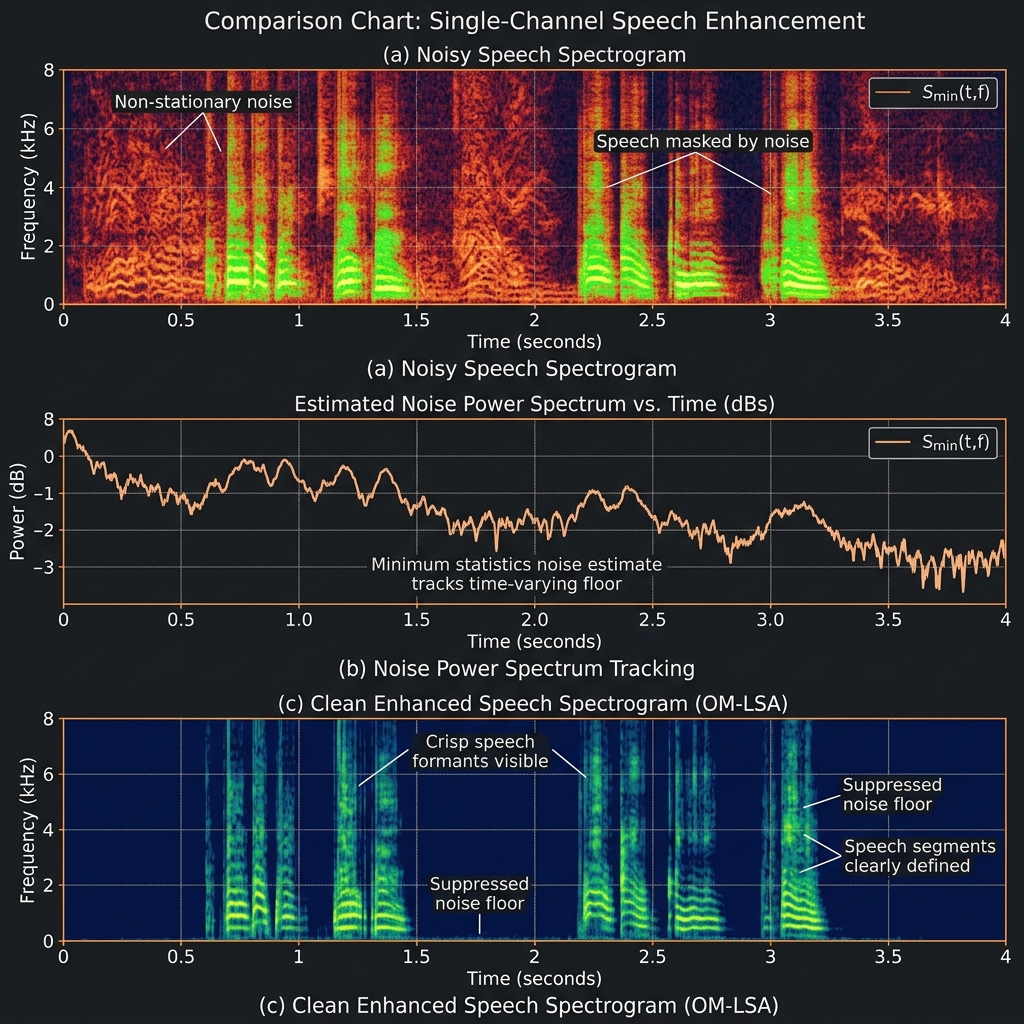
3. Log-Spectral Amplitude & Speech Presence Probability
OM-LSA formulates two essential Signal-to-Noise Ratio (SNR) metrics:
A Posteriori SNR ($\gamma_k$):
$$\gamma_k(t) = \frac{|Y(k,t)|^2}{\lambda_d(k,t)}$$A Priori SNR ($\xi_k$) (via Decision-Directed Approach):
$$\xi_k(t) = \alpha_{\text{dd}} \cdot \frac{|\hat{X}(k,t-1)|^2}{\lambda_d(k,t-1)} + (1 - \alpha_{\text{dd}}) \cdot \max\big(\gamma_k(t) - 1, \, 0\big)$$
Standard LSA Gain Function
The standard Log-Spectral Amplitude estimator minimizes the mean-square error of the log-spectra:
$$G_{\text{LSA}}(\xi_k, \gamma_k) = \frac{\xi_k}{1 + \xi_k} \exp\left(\frac{1}{2} \int_{v_k}^{\infty} \frac{e^{-x}}{x} dx\right) = \frac{\xi_k}{1 + \xi_k} \exp\left(\frac{1}{2} E_1(v_k)\right)$$Where $v_k = \frac{\xi_k}{1 + \xi_k} \gamma_k$, and $E_1(v)$ is the exponential integral function.
Conditional Speech Presence Probability ($p_k$)
Under speech presence uncertainty, the conditional probability $p_k(t) = P(H_1(k,t) \mid Y(k,t))$ is calculated as:
$$p_k(t) = \left[ 1 + \frac{1 - q_k}{q_k} (1 + \xi_k) \exp(-v_k) \right]^{-1}$$Where $q_k$ represents the a priori speech absence probability.
Optimally-Modified LSA Gain ($G_{\text{OMLSA}}$)
Finally, the OM-LSA suppression gain incorporates $p_k(t)$ and a pre-configured gain floor $G_{\text{min}}$ (e.g. -25 dB):
$$G_{\text{OMLSA}}(k,t) = \left[ G_{\text{LSA}}(\xi_k, \gamma_k) \right]^{p_k(t)} \cdot G_{\text{min}}^{1 - p_k(t)}$$$$\hat{X}(k,t) = G_{\text{OMLSA}}(k,t) \cdot Y(k,t)$$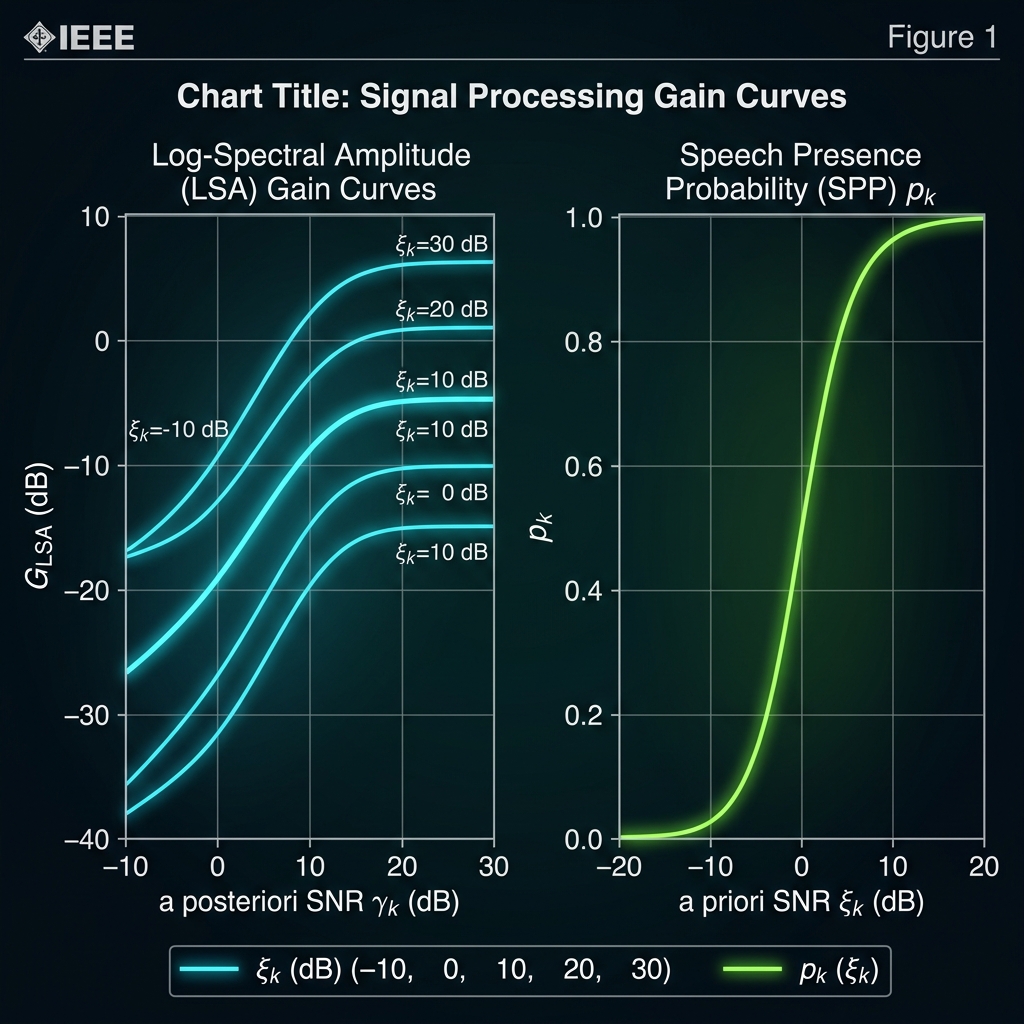
4. Python / NumPy Reference Implementation
Below is a complete Python / NumPy implementation of the OM-LSA post-filtering loop operating across STFT frames:
import numpy as np

def exp1_approx(x):
    """
    Abramowitz & Stegun polynomial approximation of Exponential Integral E1(x).
    Enables fast, native evaluation without scipy overhead.
    """
    x = np.asarray(x, dtype=np.float64)
    x_safe = np.maximum(x, 1e-10)

    # Polynomial approximation coefficients for x <= 1
    a = [-0.57721566, 0.99999193, -0.24991055, 0.05519968, -0.00976004, 0.00107857]
    poly = a[5]
    for coef in a[4::-1]:
        poly = poly * x_safe + coef
    e1_small = poly - np.log(x_safe)

    # Rational approximation for x > 1
    num = (x_safe + 2.334733) * x_safe + 0.250621
    den = (x_safe + 3.330657) * x_safe + 1.681534
    e1_large = (np.exp(-x_safe) / x_safe) * (num / den)

    return np.where(x <= 1.0, e1_small, e1_large)


def omlsa_postfilter(Y_stft, floor_db=-25.0, a_dd=0.92, a_s=0.90, a_d=0.85, win_min=60):
    """
    Applies OM-LSA single-channel speech enhancement over STFT frames Y_stft (F, T).

    Parameters:
        Y_stft   : Complex STFT matrix of shape (F_bins, T_frames)
        floor_db : Gain floor in dB (e.g. -25 dB)
        a_dd     : Decision-directed smoothing factor
        a_s      : Power spectral density smoothing factor
        a_d      : Noise estimation recursion factor
        win_min  : Sliding window length for minimum statistics
    """
    F, T = Y_stft.shape
    P = np.abs(Y_stft) ** 2
    Gmin = 10.0 ** (floor_db / 20.0)

    # Initialize noise spectrum estimate lambda_d from initial frames
    n_init = min(8, T)
    lam = np.maximum(P[:, :n_init].mean(axis=1), 1e-10)
    S = lam.copy()

    buf = np.full((win_min, F), 1e30)
    X_hat = np.zeros_like(Y_stft)
    prev_X_power = np.zeros(F)

    for t in range(T):
        p_t = P[:, t]

        # 1. Smooth power spectrum
        S = a_s * S + (1.0 - a_s) * p_t
        buf = np.vstack([buf[1:], S[np.newaxis, :]])
        Smin = buf.min(axis=0)

        # 2. Estimate speech presence & noise spectrum
        Sr = S / np.maximum(Smin, 1e-12)
        ppres = np.clip((Sr - 1.0) / 8.0, 0.0, 1.0)
        lam = np.maximum(lam + (1.0 - ppres) * (a_d * lam + (1.0 - a_d) * p_t - lam), 1e-12)

        # 3. Compute A Posteriori & A Priori SNRs
        gamma = np.maximum(p_t / lam, 1e-10)
        xi = a_dd * (prev_X_power / lam) + (1.0 - a_dd) * np.maximum(gamma - 1.0, 0.0)

        # 4. Standard LSA Gain Function
        v = (xi / (1.0 + xi)) * gamma
        e1_val = exp1_approx(v)
        G_lsa = (xi / (1.0 + xi)) * np.exp(0.5 * e1_val)

        # 5. Speech Presence Probability p_k
        q = 0.2  # A priori speech absence probability
        p_k = 1.0 / (1.0 + ((1.0 - q) / q) * (1.0 + xi) * np.exp(-v))

        # 6. Optimally-Modified LSA Gain & Filter
        G_omlsa = (G_lsa ** p_k) * (Gmin ** (1.0 - p_k))
        X_hat[:, t] = G_omlsa * Y_stft[:, t]
        prev_X_power = np.abs(X_hat[:, t]) ** 2

    return X_hat

# Example execution
if __name__ == "__main__":
    F_bins, T_frames = 257, 100
    noisy_stft = np.random.randn(F_bins, T_frames) + 1j * np.random.randn(F_bins, T_frames)
    enhanced_stft = omlsa_postfilter(noisy_stft)
    print("OM-LSA Enhanced STFT output shape:", enhanced_stft.shape)
5. Performance & Open-Source Resources
Integrating OM-LSA as a post-filter yields significant perceptual speech quality gains:
- Speech Intelligibility: Improves STOI (Short-Time Objective Intelligibility) scores by removing non-stationary noise floors while preserving consonant transients.
- Zero Musical Noise: Smooth gain transition functions eliminate isolated spectral spikes typical of standard spectral subtraction.
- Low Memory & Computational Footprint: The minimum statistics tracker and polynomial $E_1(v)$ approximation run efficiently on ARM processors and embedded DSPs.
Open-Source MATLAB Implementation
- 🧮 MathWorks MATLAB File Exchange:
The open-source MATLAB implementation of the OM-LSA single-channel speech enhancer is published on MATLAB Central:
👉 Optimally-Modified Log-Spectral Amplitude (OM-LSA) on MATLAB Central File Exchange